Motion Equivariant Convolutional LSTM: When Motion Becomes a Gauge Symmetry
in Publications
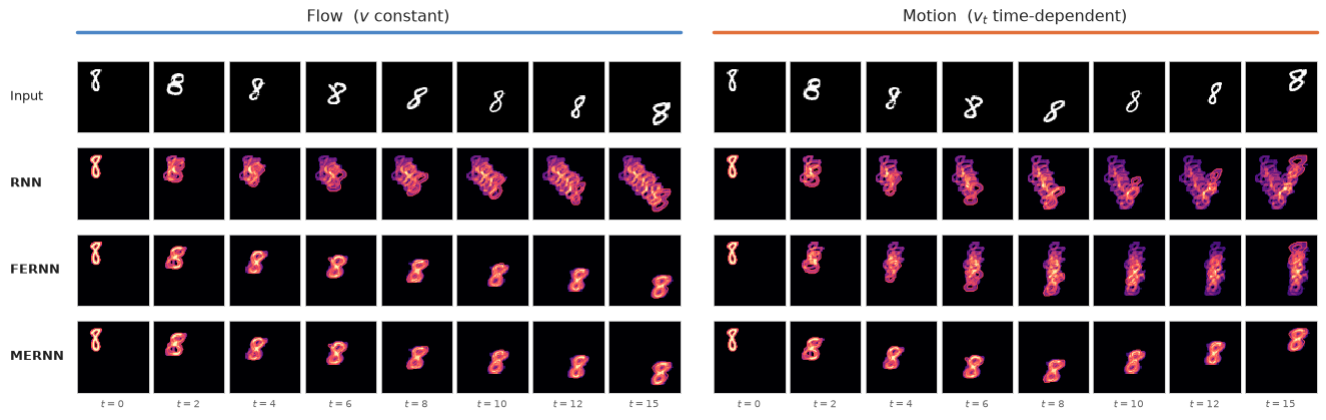 When a digit changes direction, transporting memory by its current velocity keeps earlier observations aligned with the digit.
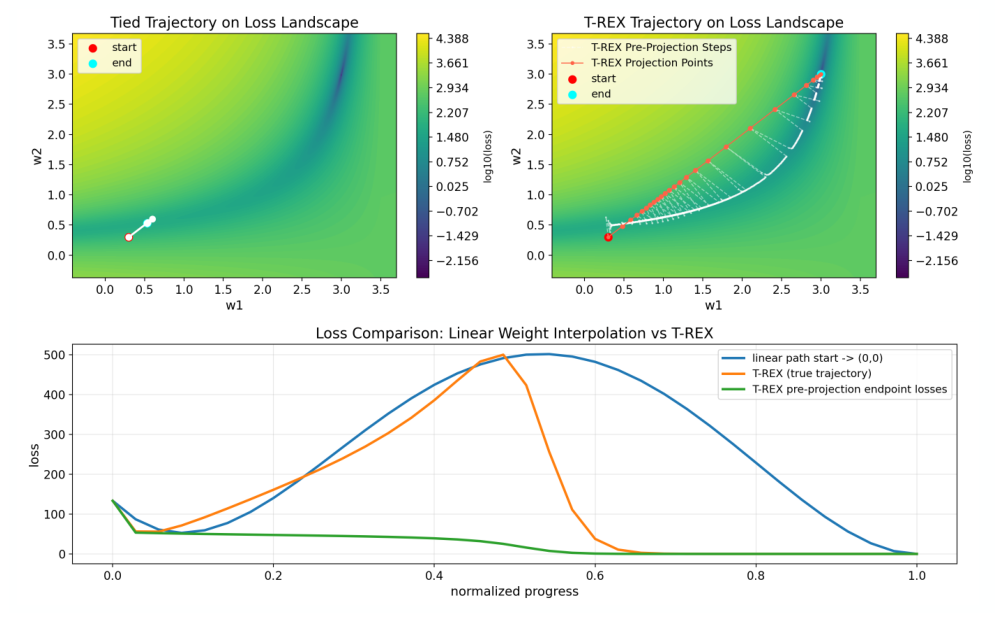 In this example, keeping the weights tied throughout training traps the optimizer. T-REX can leave the tied-weight diagonal and return to it at a lower loss.
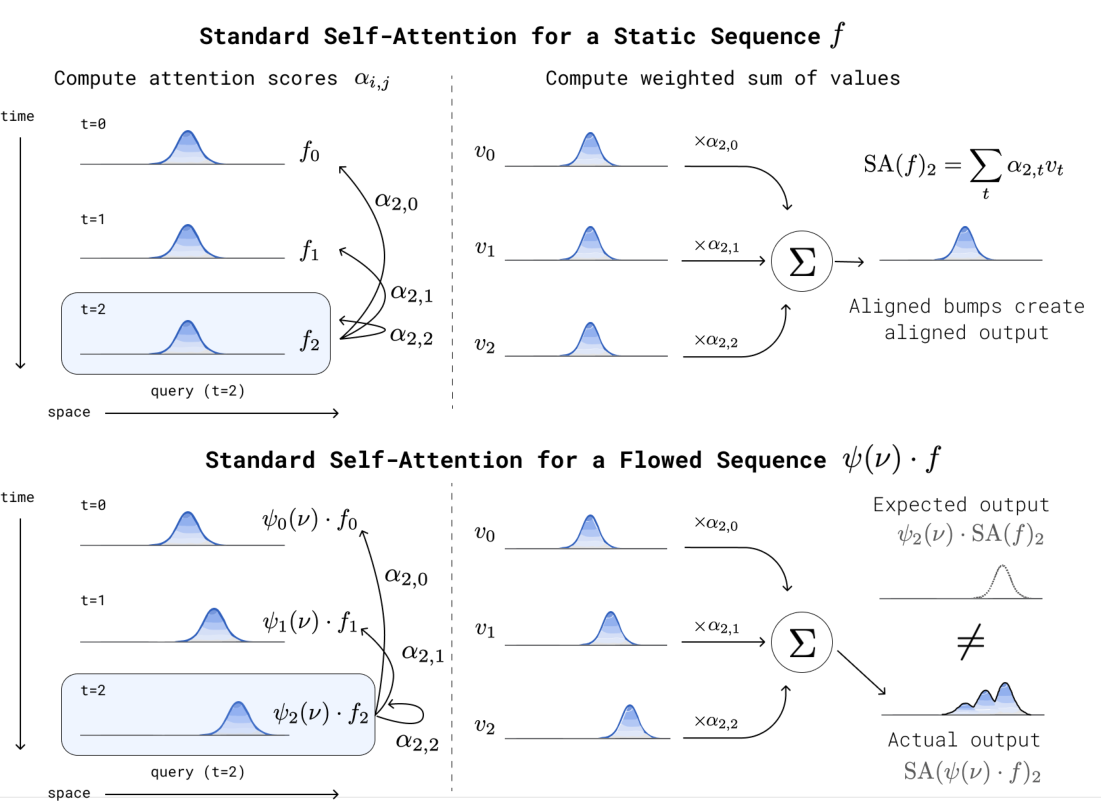 Self-attention combines features from different times. For a moving peak, those features arrive at different positions, so changing the velocity changes the output shape.
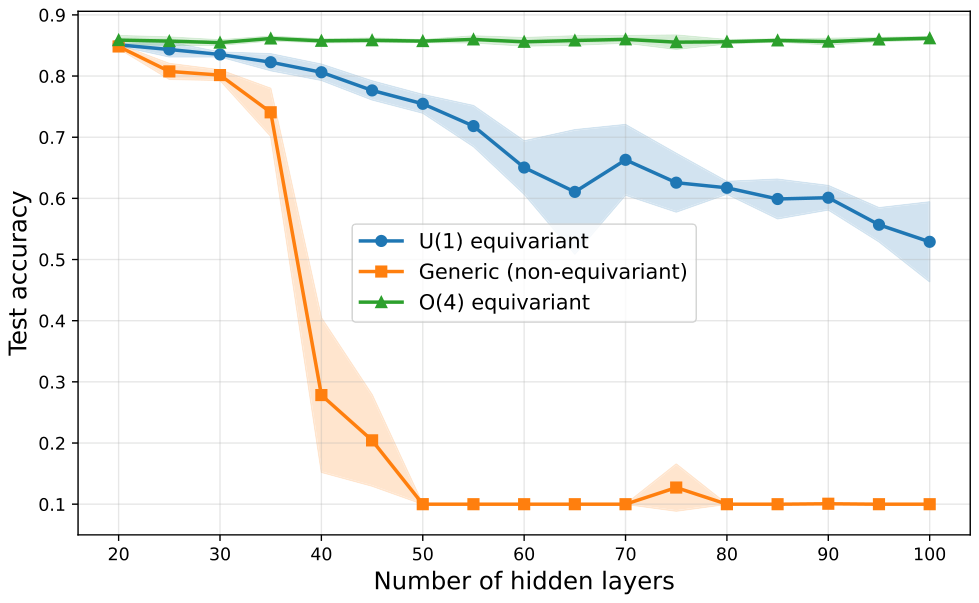 On Fashion-MNIST, the O(4)-equivariant network retains about 86% test accuracy from 20 to 100 hidden layers. The network without this symmetry reaches chance near 50 layers.
 We unify self-motion and object motion as one-parameter Lie flows and enforce flow equivariance to learn stable latent world representations that generalize to long rollouts in partially observed environments.
 We extend equivariant network theory to flows – time-parameterized Lie symmetries such as motion – yielding RNNs that train faster and generalize across sequence lengths and velocities.
 We build a score-based generative model on periodic domains by using stochastic Kuramoto synchronization as structured forward diffusion for orientation-rich images.
 We introduce AUSSM, an adaptive, input-dependent unitary SSM with skew-symmetric recurrence – closing the gap between formal expressivity and scalable long-sequence training.
 Conditioning on group elements factorizes symmetry learning into low-dimensional function generalization, yielding dramatic improvements on held-out symmetries.
 Layer–layer similarity matrices across diverse Vision Transformers reveal block structure. We propose the Block-Recurrent Hypothesis: trained ViTs can be rewritten using only k ≪ L distinct blocks applied recurrently, enabling a program of dynamical interpretability.